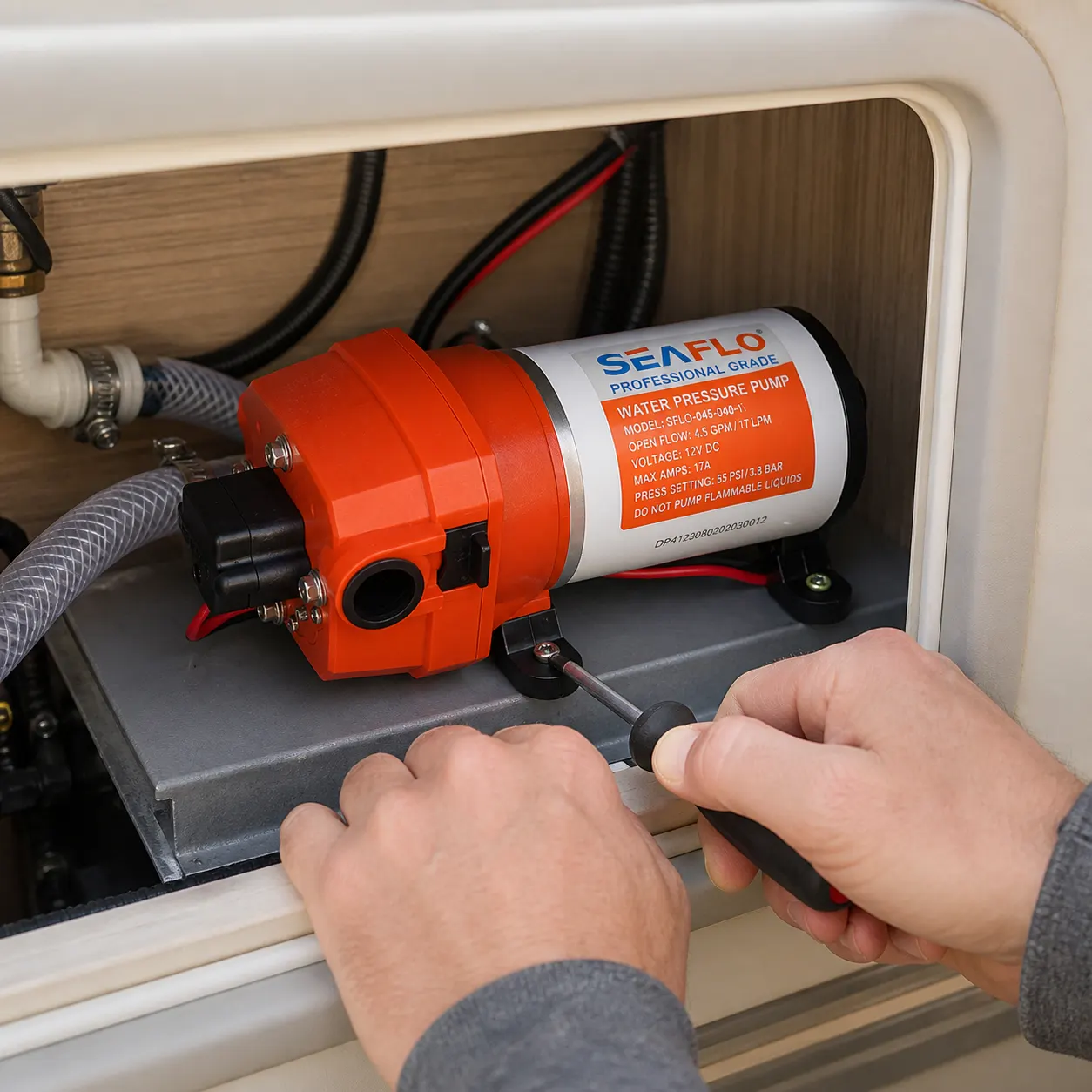
Short answer: A 12V caravan water pump replacement should be chosen by matching the old installation, not by the vehicle label alone. The Seaflowate listing identifies the SEAFLO 12V Diaphragm Pump, 045-040-41 as a compact, self-priming pump for RV, boat and sprayer applications. SEAFLO's manufacturer data for model SFDP1-045-040-41 lists 4.5 GPM, 40 PSI, 12V operation and a 12.13 A maximum current. Those figures still do not prove a drop-in fit for your caravan. Check the existing pump, hose route, connectors, mounting space and electrical protection before treating it as a replacement.
Start with the failed installation
A weak tap, a silent pump and a pump that runs without moving water can point to different faults. Before removing anything, photograph the old unit, record its label, trace the inlet and outlet hoses, and note how the 12V supply reaches it. A replacement decision is stronger when the existing system is visible on the bench rather than reconstructed from memory on a packing day.
The product category matters too. The Seaflowate page identifies a diaphragm pump and lists RV, boat and sprayer applications. That makes it relevant to a caravan water-transfer comparison, but it does not make every 12V pump a direct substitute. A pump with the wrong connection, control arrangement or physical footprint can create a second installation job.
| Check | What to record before ordering |
|---|---|
| Electrical supply | Existing voltage, polarity, fuse or circuit protection and connector |
| Water path | Tank position, inlet hose, outlet hose, clips, strainer and visible kinks |
| Physical fit | Available mounting space and access for hose and wiring work |
| Failure symptom | Silent motor, running motor with no water, weak flow or repeated cycling |
Read the documented model facts
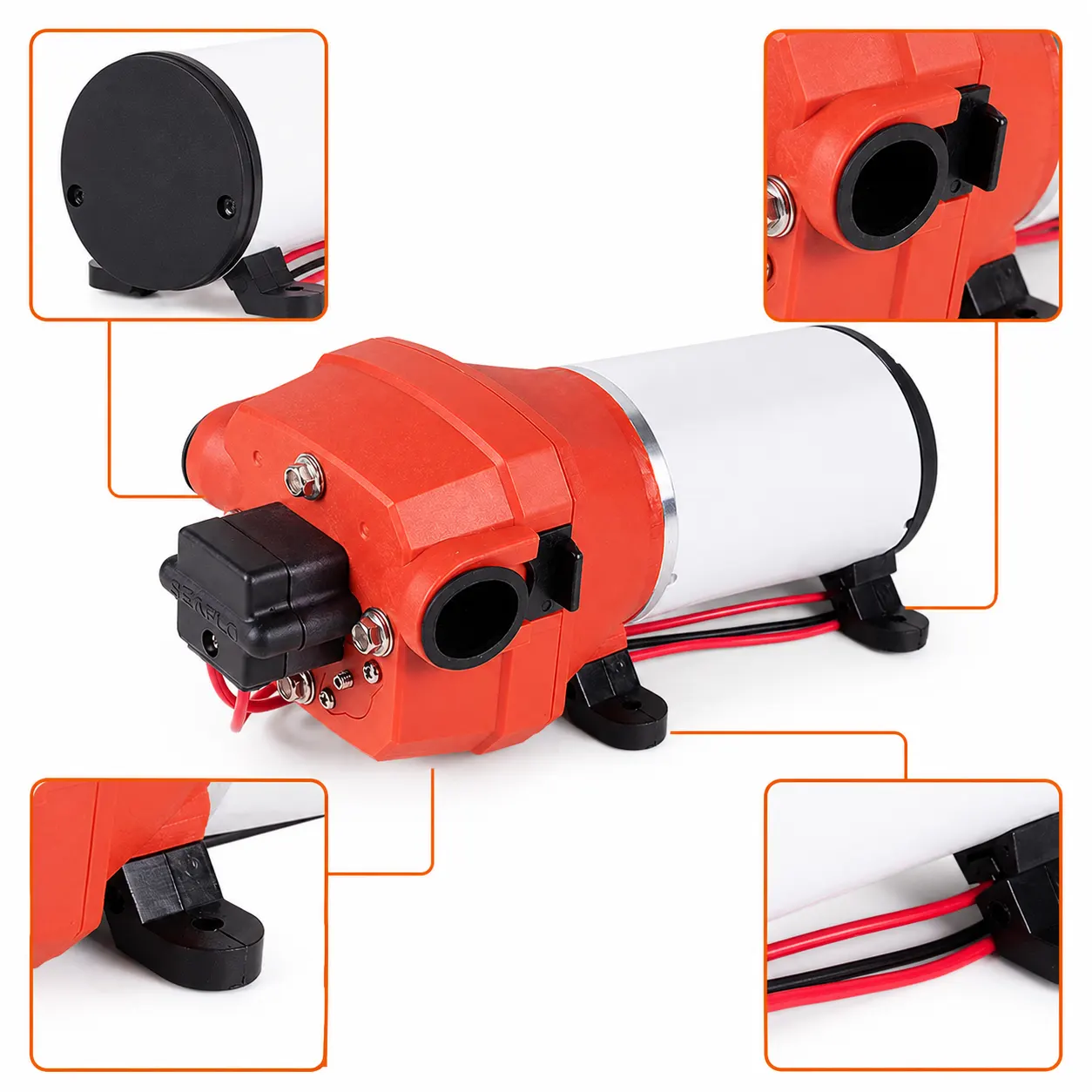
The current Seaflowate product page names the SEAFLO 12V Diaphragm Pump, 045-040-41, and describes it as compact, self-priming and intended for RV, boat and sprayer applications. The manufacturer page identifies the corresponding SFDP1-045-040-41 model and lists 12V operation, 4.5 GPM flow, 40 PSI pressure, a 12.13 A maximum current, self-priming, run-dry capability and quick-connect fittings.
Those figures describe the manufacturer's model information; they do not confirm that your caravan wiring, pressure controls or taps are suitable. In particular, the maximum current is a reason to check the existing circuit and protection, not a reason to copy a fuse value from a different installation.
Work through the replacement checks
Use a short, ordered check so the buying decision follows the real system. Stop when an essential match cannot be confirmed.
- Confirm the old pump and the proposed replacement are both intended for a 12V DC water-pump circuit.
- Compare the old pump's inlet and outlet arrangement with the manufacturer's quick-connect description and ask for the exact fitting size if it is not shown.
- Check the available mounting space and hose routing without assuming the replacement's dimensions or mounting pattern.
- Compare the manufacturer's 12.13 A maximum current with the existing circuit documentation and have uncertain wiring checked by a competent person.
- Test the old system for an empty tank, blocked line, air leak, loose connection or fuse fault before declaring the pump failed.
Limits before you commit
The manufacturer does not specify your particular caravan's compatibility, exact hose size, mounting clearances, included UK wiring parts, service life or noise level. The current product page also does not establish potable-water certification, a complete installation kit or a guaranteed drop-in replacement. If any of those details controls the purchase, ask for model-specific documentation before ordering.
A pump can be technically capable and still be the wrong part for a system with a different connector, tank arrangement or pressure-control method. Keep the old unit intact until the replacement specification and return conditions have been checked.
Related guides and product details
Treat the SEAFLO 045-040-41 as a replacement candidate when the 12V category, documented pump data and your physical installation agree; do not treat the product name as proof of a direct caravan fit. Read Caravan Diaphragm Pump 12V Self-Priming: What It Solves for related guidance. Read Motorhome 12V Water Pump Not Priming: Checks Before Replacement for related guidance. Review the documented specification on the SEAFLO 12V Diaphragm Pump, 045-040-41 product page before ordering.
Sources and safety context
- Supports the product identity, 12V configuration, compact diaphragm-pump description, listed applications, price and fulfilment terms Current Seaflowate product page.
- Supports the SFDP1-045-040-41 model data for 12V operation, 4.5 GPM, 40 PSI, 12.13 A maximum current, self-priming, run-dry capability and quick-connect fittings SEAFLO 41-Series diaphragm pump specifications.